EdgeMax mounts at the wall–ceiling edge and projects sound down and out into the room.
The EM90 is for corners and the EM180 for walls; the LP models fit shallow plenums.
One EdgeMax can cover the area of up to four conventional ceiling loudspeakers.
Wall and corner mounting reinforces the bass, so many background music systems may not need a subwoofer.
Conventional ceiling loudspeakers handle a huge range of projects, and we make plenty of them. A well-planned grid of standard ceiling loudspeakers delivers consistent coverage, and it needs space in the middle of the ceiling.
In retail, hospitality and conference spaces, the middle of the ceiling is crowded real estate. Lighting, HVAC diffusers, projectors and sprinklers all compete for it, and the walls below are often glass, mirrors, artwork or millwork that nobody wants a surface-mount loudspeaker on. The client still expects music and speech to feel full and present everywhere, with nothing in view but a grille.
In rooms like these, the best open real estate is often the edge, and that’s the position EdgeMax was designed for.
Bose Professional introduced EdgeMax directional in-ceiling loudspeakers in June 2017. The idea is simple: mount the loudspeaker at the wall–ceiling edge and project sound down and out into the room. It acts like a surface-mount loudspeaker and looks like an in-ceiling loudspeaker.
Why the Edge Is Usually Off-Limits
Put a conventional ceiling loudspeaker right against a wall and part of its cone lands on the wall, where nobody is listening. So, most layouts keep their loudspeakers out in the room, aim them straight down and overlap their cones until coverage evens out. In a wide room, that means density: more loudspeakers, closer together, in the middle of the ceiling.
EdgeMax works differently. It projects an asymmetrical pattern that starts along the wall and reaches out across the room, carrying high-frequency sound across rooms up to 65 feet (20 m) wide from perimeter locations alone. It comes in two patterns for the two perimeter positions:
EdgeMax EM90: 90° of horizontal coverage, designed for room corners
EdgeMax EM180: 180° of horizontal coverage, designed for mounting along a wall
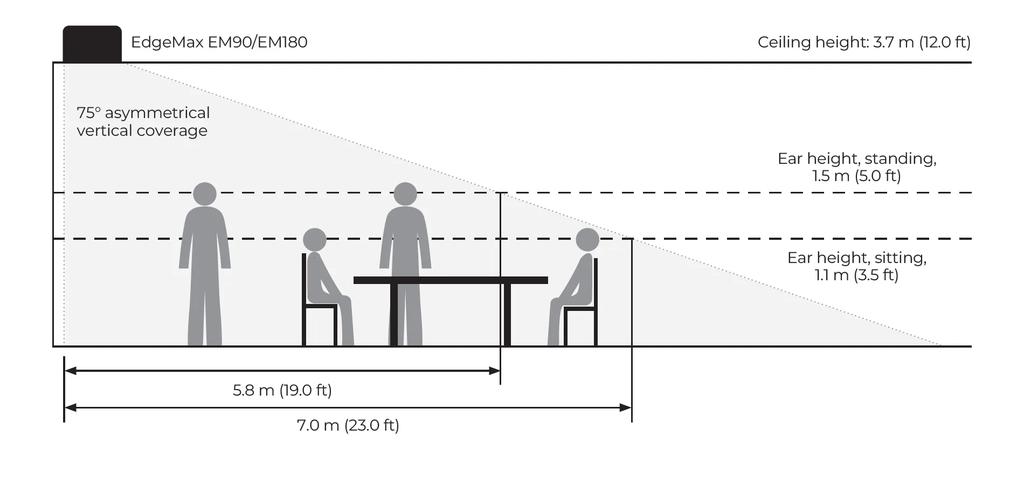
Mounted at the wall–ceiling edge, EdgeMax projects its pattern down the wall and out across the room.
How PhaseGuide Shapes the Pattern
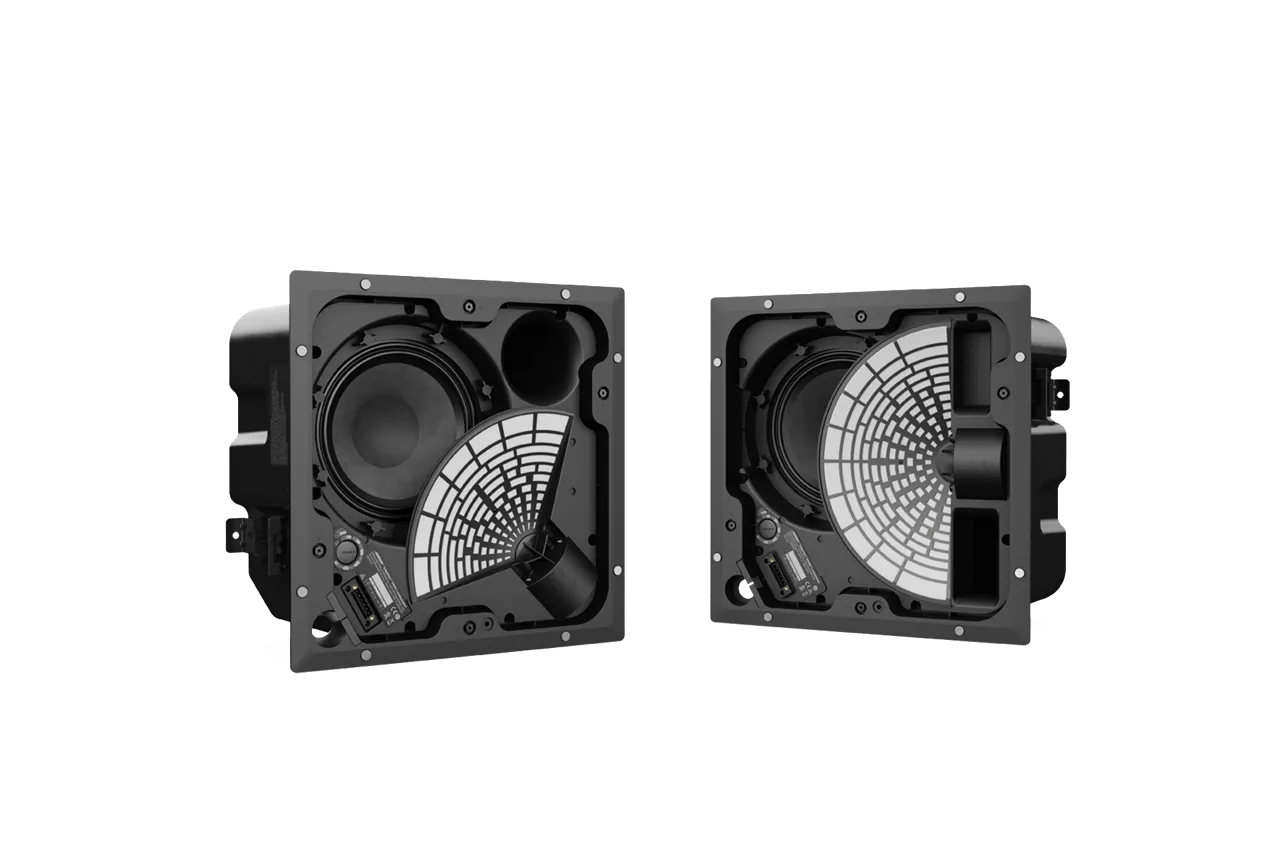
Both models are true two-way designs. An 8-inch woofer sits in a tuned, ported enclosure, and a compression driver mounted to a PhaseGuide structure handles the high frequencies, with a 1 kHz crossover between them.
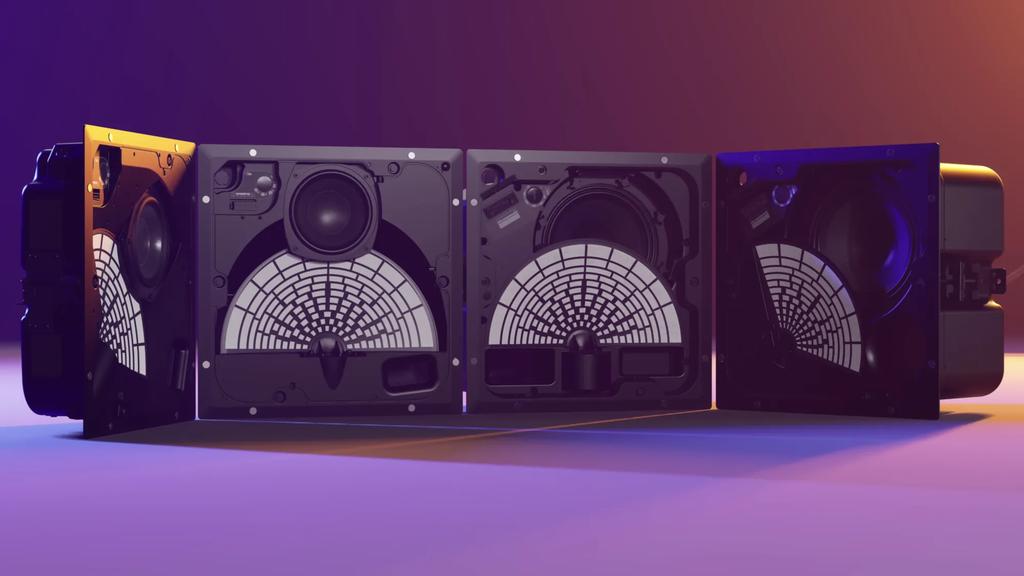
PhaseGuide technology is what makes the perimeter position work. Paired with the compression driver, it shapes that asymmetrical pattern. On the EM90 and EM180, the vertical pattern runs from 0°, straight down and along the wall, to 75° out into the room. That puts the top of the pattern about 15° below the ceiling, aimed at listeners.
Add 90° or 180° of horizontal coverage, and a loudspeaker at the edge of the room can reach the people in the middle of it.
The EdgeMax EM90 and EM180 with grilles removed, showing the PhaseGuide that shapes each pattern.
Fewer Locations, More Bass
Coverage Reduces the Number of Locations
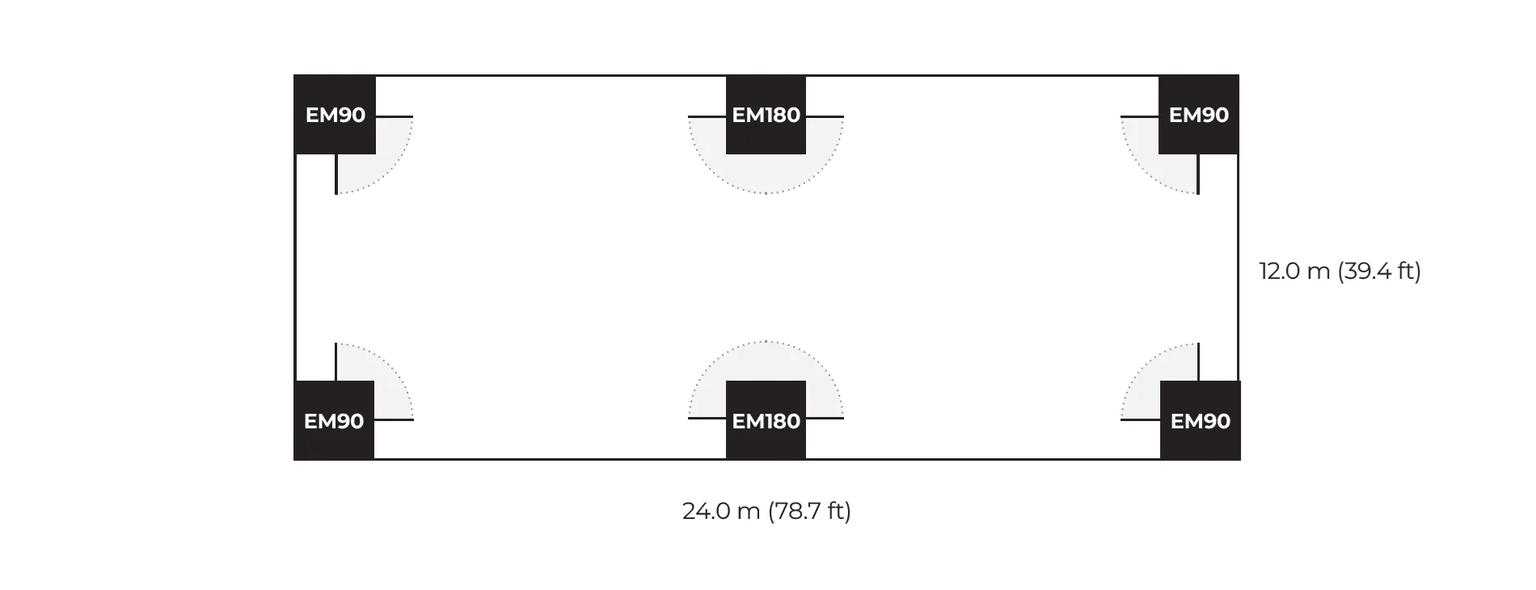
One EdgeMax can cover an area that would otherwise take up to four conventional ceiling loudspeakers. In a large retail or event space, a row of EM180s along the perimeter can cover ground that might otherwise need 8–10 in-ceiling or pendant loudspeakers.
With every location at the perimeter, the middle of the ceiling stays clear for lighting, diffusers and sprinklers, and the walls stay free for whatever the architecture needs.
EM90 loudspeakers in the corners and EM180 loudspeakers along the walls cover the room from the perimeter, leaving the middle of the ceiling clear.
Boundary Loading Adds Bass
The extra low end comes from where the loudspeaker sits. At low frequencies, nearby surfaces reinforce a woofer’s output, and a woofer at the wall–ceiling junction has more of them than one in the middle of the ceiling: an EM180 at a wall gains one boundary, and an EM90 in a corner gains two. In theory, each added boundary is worth roughly 3 to 6 dB, and the full gain arrives only when the woofer is close to the surface relative to the wavelength. Real rooms give back less, because drywall and ceiling tile aren’t rigid and the woofer sits some distance from the wall.
EdgeMax loudspeakers have a usable frequency range down to 45 Hz. That’s the −10 dB point, measured in a corner for the EM90 and against a wall for the EM180, with recommended EQ. For background music in retail and hospitality, that’s often all the low end a room needs. Higher-energy rooms, like fitness studios and dance floors, still tend to add subwoofers. Five Common Subwoofer Myths — Debunked covers how to place them.
The LP Models: Perimeter Coverage for Shallow Plenums
Not every ceiling has room for a 9-inch backcan.
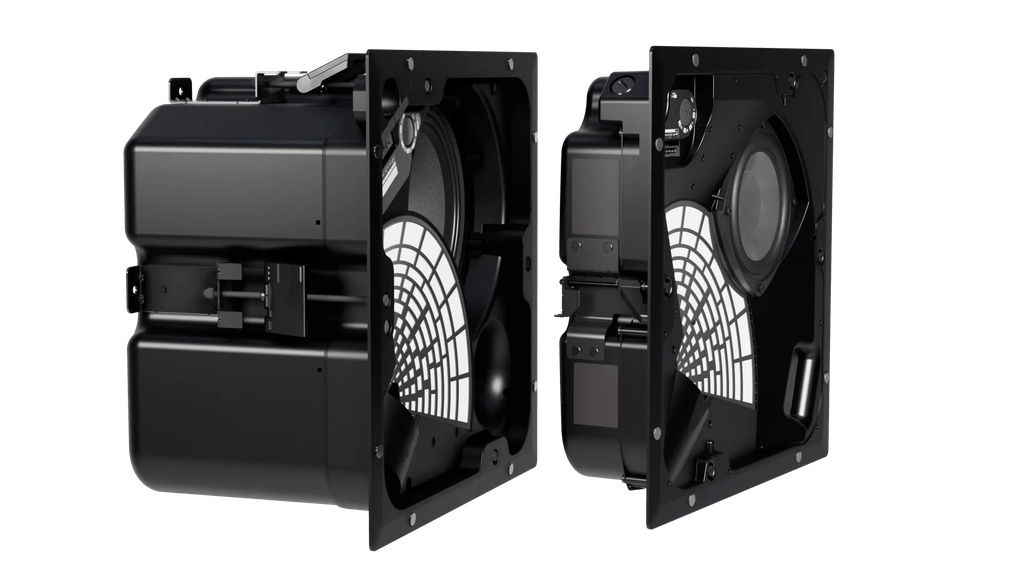
The EdgeMax EM90-LP and EdgeMax EM180-LP were previewed at InfoComm 2024, where EdgeMax LP won a Best of Show award from AV Technology, and became globally available on November 4, 2024. They use a 4-inch backcan, 60% shallower than the original models, with a 5.25-inch woofer alongside the compression driver and PhaseGuide. Vertical coverage widens to 80°, which suits lower ceilings. The LP models fit 8–12 ft (2.4–3.7 m) ceilings, and the originals 9–20 ft (2.7–6.1 m) or higher.
The EM90 (left) beside the EM90-LP, with its 4-inch backcan.
The application split follows the output. The EM90 and EM180 handle higher-SPL work in fitness clubs, bars and restaurants, houses of worship, and performance spaces. The LP models suit conference rooms, low-ceiling hospitality spaces, retail, and retrofits.
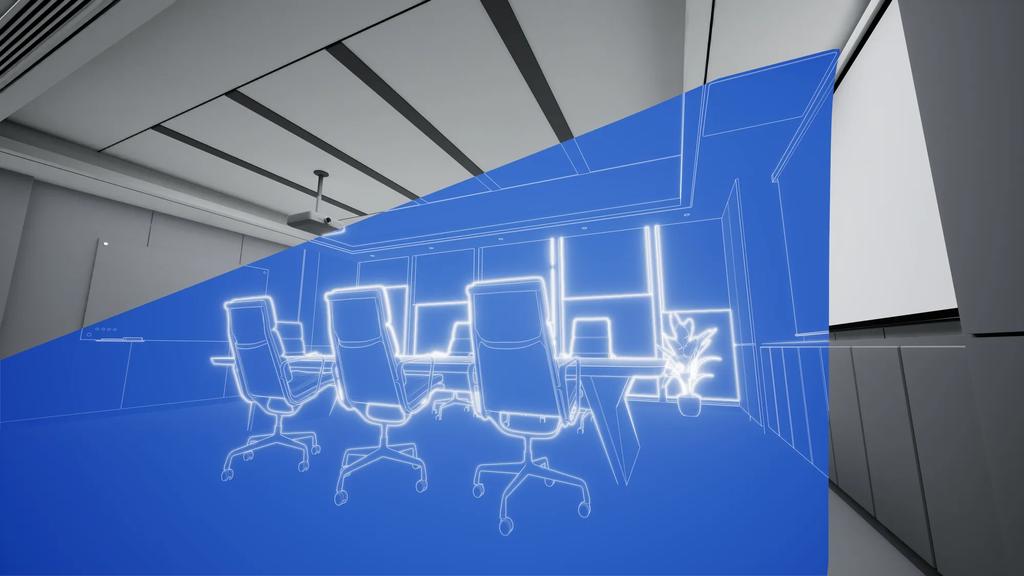
Conference rooms have been a core EdgeMax application since launch. For a small room, under about 10 × 15 ft (3 × 4.5 m) with a 9–12 ft ceiling, a single EM180 or EM180-LP above the display does the job, or a pair of EM90s in the corners for stereo.
A single EM180-LP above the display can cover a small conference room.
Where Perimeter Coverage Earns Its Place
Tod’s, Boston: Four Locations, No Subwoofer
At the Tod’s Boutique in Boston’s Copley Place, integrator OnSite Media covered the store with four EdgeMax EM180 loudspeakers. The final system uses fewer loudspeakers than the one originally specified.
“We put them near the corners, against the walls, and that enhances their low-frequency response, so you have full-range sound covering the entire store from just four speaker locations, without the need for a sub,” said Randy Prondzinski, Head of Engineering at OnSite Media.
General Bourke, Sydney: Keeping Sound Where It Belongs
General Bourke, a pub in Parramatta, puts a sports bar, gaming room, VIP lounge, bistro and main bar under one roof. Integrator Total Concept Projects used EdgeMax EM90 and EM180 loudspeakers in the sports viewing areas, where directional coverage kept sound from bleeding into neighboring spaces. More units went directly over the bars, aimed away from where customers order.
“Because of the directional sound, it actually allows, in a normal conversational voice, patrons and staff to engage with each other — which is the traditional premise of hospitality,” said Paul Devine, COO at Iris Hotel Group.
Upstairs, the after-hours dance floor pairs EdgeMax with F1 Subwoofers for the extra low end a nightclub needs.
Gold’s Gym Venice Beach: When the Walls Are Off-Limits
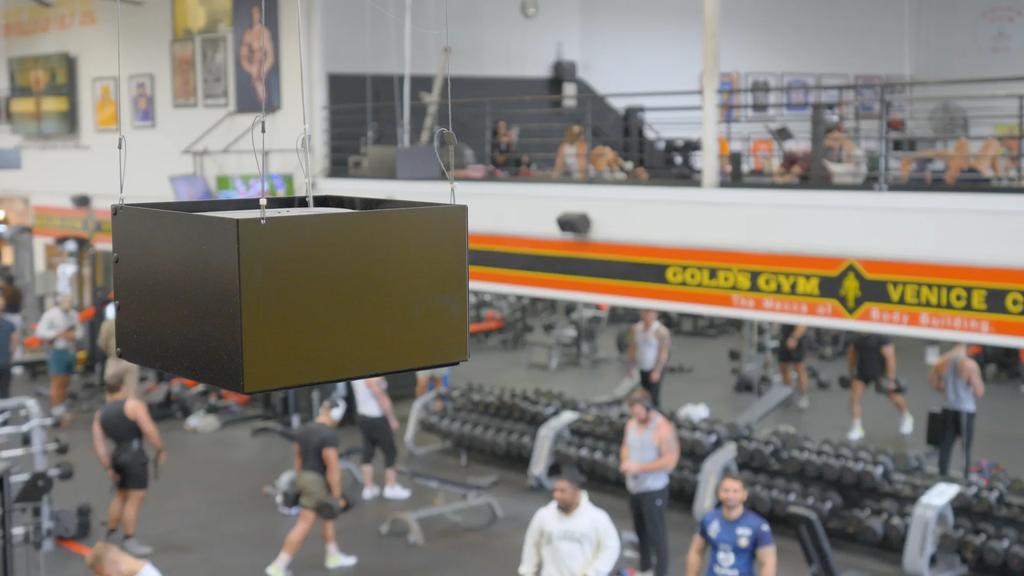
Gold’s Gym Venice Beach posed a different constraint. Its ceilings are open and industrial, with nowhere to recess a loudspeaker, and its walls are covered in memorabilia the gym can’t replace. Integrator Mountain Media hung EdgeMax EM180 loudspeakers in custom suspended enclosures built for the project, so the gym gets directional coverage with nothing mounted on its walls.
Suspended away from any wall, EdgeMax gets no boundary loading here, and the system adds DesignMax DM10S-SUB and MB210-WR subwoofers for low end.
At Gold’s Gym Venice Beach, an EdgeMax EM180 loudspeaker hangs in a custom suspended enclosure, keeping the memorabilia-covered walls clear.
Ostehuset, Stavanger: Openings That Were Already There
Ostehuset fills the former Norske Bank building in central Stavanger, Norway, with a deli, restaurant, bar, conference center, brewery and tasting room. Norwegian integrator ShowRoom installed EdgeMax loudspeakers in preexisting openings throughout the common areas, conference rooms, and wine tasting room, avoiding any impact on the historic structure.
“It worked perfectly to reuse the holes from the previous ceiling lamps to mount the new loudspeakers,” said Tom Helge Sørenssen, CEO of Ostehusetgruppen.
Putting the Perimeter to Work
EdgeMax gives designers another place to put the source. Consider it when:
The middle of the ceiling is spoken for by lighting, diffusers, sprinklers or projection
The walls are unavailable because of glass, mirrors, artwork, memorabilia or doors
You want surface-mount presence with an in-ceiling look
A wide room needs coverage from fewer locations
The plenum is shallow, which is where the LP models come in
Explore the full EdgeMax series for models, specs, and case studies.
Talk with our design team
Connect with our design support engineers to review your project and plan perimeter coverage for your space.